Pass Any Nursing Certification Exam Now & Pay After You Pass.  Contact Us!

National Healthcareer Association (NHA): Certified EKG Technician - CET

Earn the NHA's CET credential and become a certified EKG technician trained in lead placement, monitoring, and rhythm interpretation basics.

98%

Passed using
our practice tests.

99%

Found the study guide
effective and helpful.

100%

Pass the CET exam with our premium support.
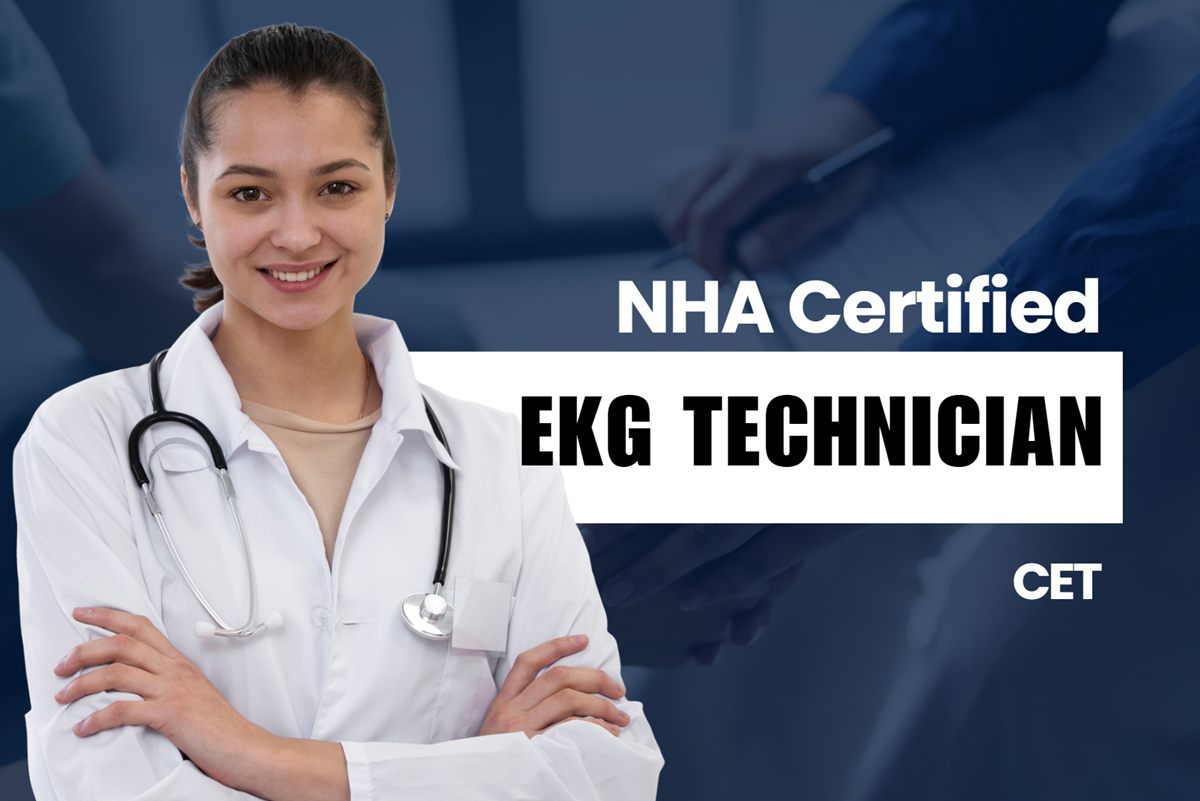
CET - Certified EKG Technician

Get our Premium Exam Support with Guaranteed pass on 1st attempt and pay after you pass

Level
Entry-level Certification
Field
Cardiology
Role
EKG Technician
Subject
Electrocardiography

The CET (Certified EKG Technician) is the NHA's credential for technicians who perform electrocardiograms, Holter monitor application, and stress tests. The exam covers safety and compliance, EKG acquisition, EKG analysis, and patient care related to cardiac monitoring. It includes 100 scored questions plus 20 pretest items and is allowed 2 hours 10 minutes.

Assessed on this Exam

The CET exam evaluates your knowledge across these areas:

EKG Acquisition

12-lead placement, Holter and event monitoring, and stress test setup.

EKG Analysis

Wave, segment, and interval identification; basic rhythm recognition.

Patient Care & Safety

Patient prep, identification, communication, and emergency response.

Compliance & Documentation

HIPAA, accurate documentation, equipment maintenance, and quality control.

What You'll Find in Our
CET Question Bank

Our question bank is built to help you master the CET exam with targeted practice and clear explanations.

Realistic Practice Questions

Questions structured like the real CET exam, including the question styles you'll see on test day.

Detailed Explanations

Know not just the right answer but why the others are wrong - so every question teaches you something.

Comprehensive Coverage

Every domain on the CET content outline is represented across the question sets.

Exam Readiness

Build the confidence you need to walk into test day calm and prepared.

Practice for the Exam

Assess your knowledge and experience the CET format before taking the actual test.

Click here for exam support
CET

How to Use Our CET
Questions for Best Results

Start Early

Mix practice questions into your study from day one to find the topics that need more attention.

Review Often

Revisit questions you have seen before. Spaced review locks in long-term retention.

Simulate Exam Conditions

When ready, attempt a full set in one timed sitting to build the stamina you need on test day.

Analyze Your Performance

Use the explanations to understand each mistake and concentrate on the weak spots.

View CET Questions
and Answers Here!

CET - CET Practice Exam Questions #01
Prepare effectively with these curated question sets.
40 Minutes estimated completion
Set 01
CET - CET Practice Exam Questions #02
Test your knowledge with a new set of questions.
40 Minutes estimated completion
Set 02
CET - CET Practice Exam Questions #03
Challenge yourself with advanced questions.
40 Minutes estimated completion
Set 03
CET - CET Practice Exam Questions #04
Boost your preparation with these practice questions.
40 Minutes estimated completion
Set 04
CET - CET Practice Exam Questions #05
Finalize your revision with this comprehensive set.
40 Minutes estimated completion
Set 05

Dive Deeper into CET -
Certified EKG Technician

Do I need to read EKGs at a clinician level?

No. The CET focuses on accurate acquisition and recognition of basic rhythms and life-threatening patterns. Diagnostic interpretation remains the role of the physician.

What is the eligibility for CET?

High school diploma or equivalent plus either an EKG training program in the last five years or one year of relevant supervised experience in the last three years.

What should I focus my study on?

Lead placement, basic rhythms, artifact troubleshooting, and the cardiac conduction system. Our CET practice sets give you targeted reps on each.

Prepare for CET with Confidence

Earning the CET credential opens doors to roles in cardiology departments, telemetry units, stress test labs, and outpatient cardiac monitoring clinics.